


Fight scenes shouldn’t read like instruction manuals.
That might impress a martial arts junkie, but for most readers, it’s confusing, boring, or both.
I Start With Emotion, Not Technique
Real fights aren’t flashy. They’re messy. Chaotic. Ugly.
They’re not cinematic sequences of clean combinations, they’re emotional outbursts wearing fists for armor.
When I write a fight scene, I ask: What is this character feeling that makes their body move like this?
Instead of “He threw a punch and missed,”
I ask: Why did he miss?
Was he trembling from fear?
Was his judgment clouded by rage?
Was his training abandoned the second real pain showed up?
Those are the details that matter.
Here’s an example of how to write a fight scene with emotion:
"The insult erased Roger’s training. Rage took over. Ten years of bag work, rope skipping, and early morning runs flushed down the drain. He swung hard and wild, tears spilling from his eyes, a sloppy punch fueled by anger rather than instinct. It was worse because the insult wasn’t about him, it was about his wife. An accusation that twisted something deep inside him, changing his physiology, hijacking his control.
Johnson slipped the punch easily, almost casually, and drove a counter into Roger’s ribs. The pain registered instantly. Roger’s face twisted, breath catching, a thin line of blood spilling from his nose and glistening down his sweat-slicked chin.”
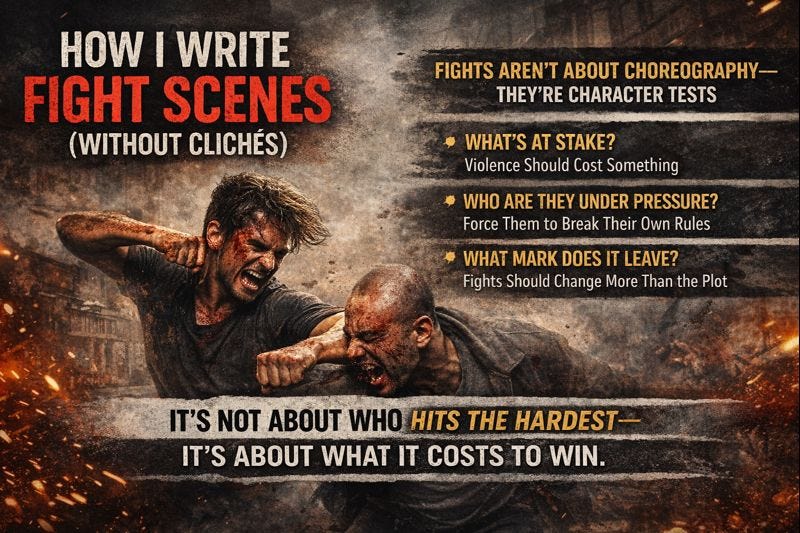
Not Everyone Fights the Same—And That’s the Point!
Some characters are trained. Some flail. Some freeze.
In one scene I wrote, Jag, a trained boxer, goes head-to-head with Brian Cruz, a cop whose only combat training came from the police academy. Jag’s hits are precise, mechanical, and become dangerous the more emotional he becomes (compared to the example of Roger I provided earlier)
Jag was throwing both punches and expressing his hatred for the police.
And Brian felt every ounce of it.
The imbalance was immediate. Jag was the better fighter. But that wasn’t the scene’s point.
What mattered was that the cop needed to win, and Brian couldn’t win clean. So he cheated.
Because in life, how someone fights tells you who they are.
You fight differently in a fight on a dojo with rules compared to fighting on the street. Which is why Rocky 5 is one of my favorite installments. It is truly under rated as a film. Check out this depiction of the street fight between Balboa and Tommy Gunn, and how much different it feels that a fight in the ring:
Every Fight Is a Moral Test
The real question is: What is this character willing to become to survive?
Do they stick to their rules?
Do they break them?
Do they sacrifice a piece of themselves just to make it out alive?
A fight isn’t just physical damage. It’s a test of a character’s moral compass.
It’s not how hard they hit. It’s how they hit.
I Don’t Write Just Cool Fights
If the only thing your fight scene does is look cool, it’s dead weight.
Violence should mean something. It should scar. It should scratch at the soul and leave a mark. You should be able to remember a fight scene, not for the actual movements, but for the emotions.
I want readers to walk away from a fight scene feeling something:
Perhaps they change their view on a character
Perhaps they find themselves rooting for the villain
Perhaps they realize that the character who had been training so long to become a perfect fighter, is in fact just human, who feels pain just like all of us.
Because if a fight doesn’t leave a mark, it isn’t really a fight—it’s just noise.
One of the best examples of a fight scene that’s both visually compelling and consequential is the hallway scene from Daredevil (Season 1). The violence isn’t clean or flashy. You see only a handful of clearly executed moves, and much of the fight happens in near darkness. At times, you don’t even see Daredevil at all, you hear him. Heavy breathing. Bodies hitting walls. Exhaustion setting in. Check it out:
The Goal Isn’t Choreography—It’s Consequence
Fight scenes shouldn’t be noise between plot points.
When a fight is done right, when it reflects character, pain, choice, and consequence, the reader doesn’t skim past it. They lean in. They feel it. And long after the details fade, they remember the emotion it left behind.
The best fights aren’t about who wins. They’re about what’s revealed, and what changes because of it.