


What makes a villain truly unforgettable?
If a villain exists only to make the hero look strong, the audience will forget them as soon as they’re introduced. If they just show up, deliver a monologue, maybe throw a few punches, and then disappear into the credits, they may serve the plot, but they aren’t etched into the audience’ memory.
A great villain does the opposite.
A great villain disrupts everything. Not just through violence or schemes—but through emotion and philosophy. They force the hero to confront themselves. Their failures. Their compromises. Their blind spots.
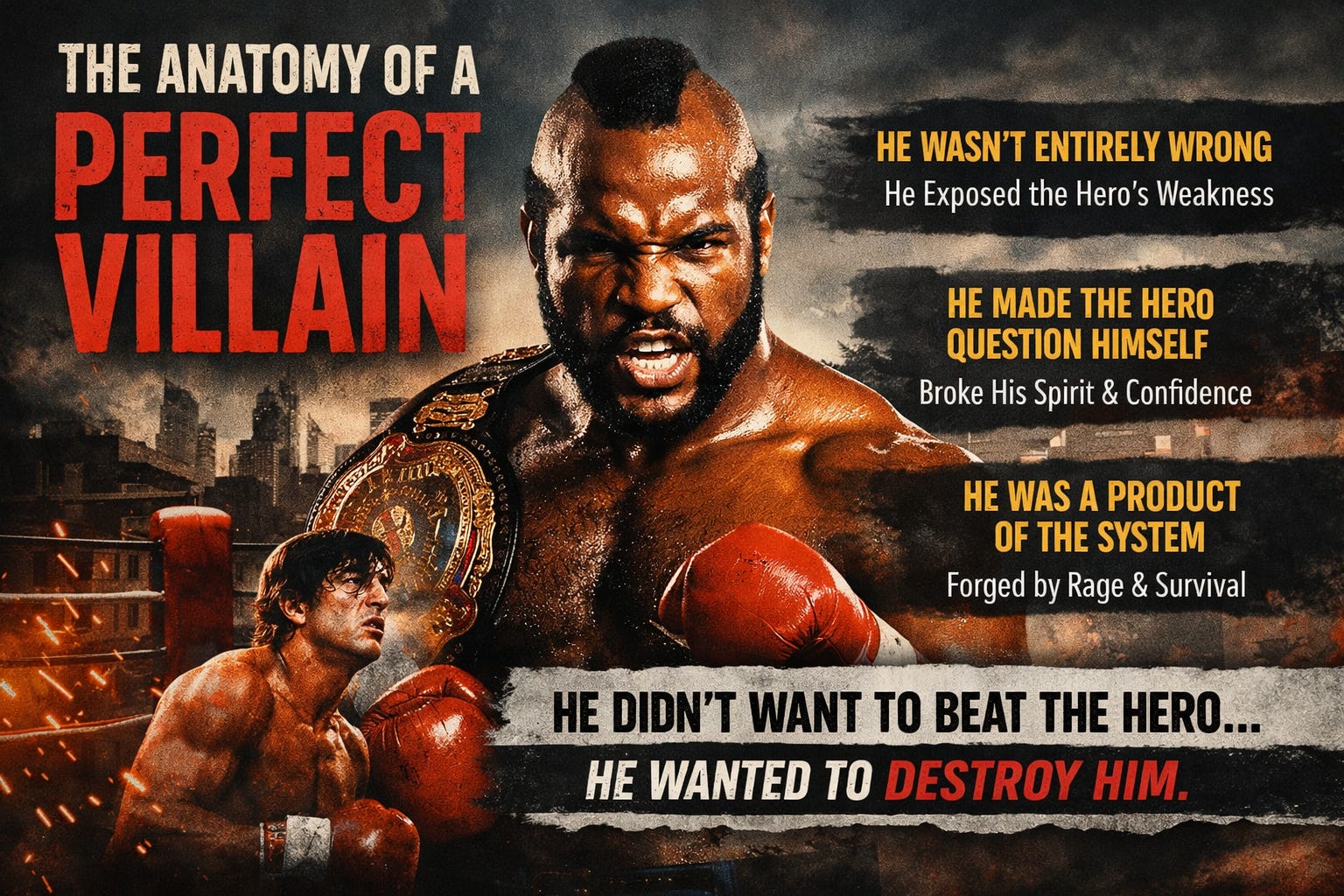
This was done beautifully by Clubber Lang from Rocky 3. He accused Rocky of coasting. He called out the truth, that Rocky had gone soft. Rocky has lost his hunger, his fighting spirit, and the embraced the world of flashing cameras. In some ways, Clubber was Rocky’s consequence, not just his opponent.
Lang didn’t just beat Rocky physically, he shattered his confidence. He heckled him publicly without fear. He took away his mentor, his father figure. He made Rocky feel true pain, just like he promised.
Great villains make the hero question who they are and whether they were ever worthy of the title or position they hold. In many ways, Clubber Lang was Rocky if Rocky never went soft, never had Micky, and never met Adrian. Lang represented Rocky’s alter ego from a different timeline.
Here’s Micky explaining to Rocky what makes Clubber Lang so dangerous, and that he’d set up easy fights for him. You can see the exact moment that Rocky begins to question himself and his abilities:
The Dark Mirror Effect
Some of the most compelling villains feel like they were once the hero, or could have been. They’re twisted by grief, betrayal, or ideology, but you can still see what they could have become. They make you wonder: What if the roles were reversed?
Think about Deathstroke in Season 2 of Arrow.
He wasn’t just some power-hungry warlord. He had a deeply personal grievance. He had history with Oliver Queen. And when that bond was broken, he became something darker—but not irrational. Every step he took made a certain amount of sense. That’s what made him dangerous. That’s what made him unforgettable.
He didn’t just fight Oliver physically—he psychologically unspooled him. He made you question whether Oliver deserved to win. He made you see the consequences of the hero’s actions.
Years later, you might not remember every episode or every subplot,
but you remember Deathstroke. Because he wasn’t just a villain. He was a reckoning. Just see how he psychologically breaks down the hero in this scene:
The Core Ingredients of a Great Villain
Here’s what they usually have in common:
A personal connection to the hero - their lives are intertwined, and so is their pain. There is something real that they’ve lost, and they blame the hero for it, or someone or something connected to the hero.
A believable motivation– They might be wrong in their method, but you understand why they do what they do.
Moral pressure – They force the hero to question everything. Someone who seemed like they could never be broken, get closer and closer to shattering.
A philosophy– They aren’t just chaos agents; they believe something. And they make the audience wrestle with that belief.
Presence– They don’t need constant screen time. But when they show up you feel them before they speak.
Why This Matters in Vigilante Fiction
Vigilante fiction already blurs the line between hero and criminal. A great villain takes that tension and stretches it until it snaps.
A perfect villain doesn’t just challenge the hero. They challenge us. They make the story feel heavier, more real, more human. And they make the reader or viewer wonder: How far is too far?