


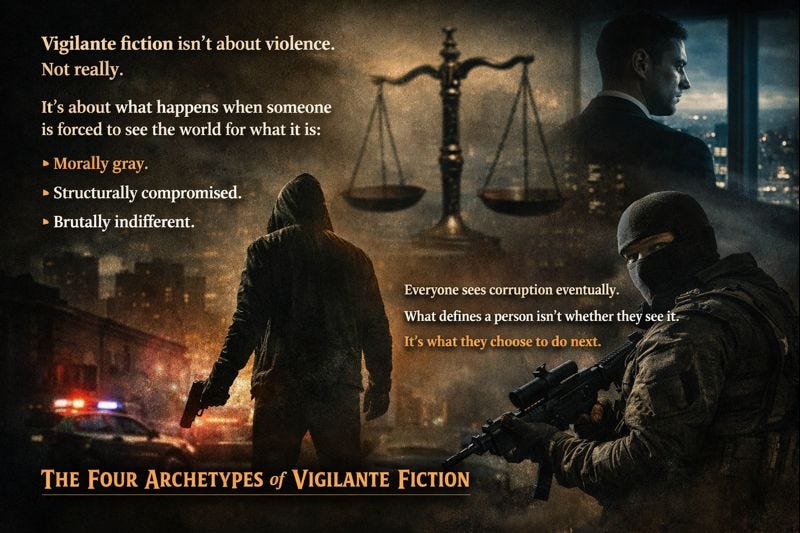
Vigilante fiction is about what happens when someone is forced to see the world for what it is: morally gray, structurally compromised, and brutally indifferent.
It’s about what they do when the system that promised to protect them either disappears, or turns against them.
Everyone sees corruption eventually.
What defines a person isn’t whether they see it.
It’s what they choose to do next.
In my work, that choice falls into four core archetypes.
Category 1: The Faithful Believers
These characters still believe the system can work.
Even when they’ve seen it fail, they choose reform over rebellion.
They trust that laws, institutions, and order, however imperfect, are better than chaos.
But their conviction isn’t blind loyalty. Instead, they’re the ones who follow the rules on purpose, even when it hurts…and especially when it hurts.
A great example of a Faithful Believer in fiction is Commissioner James Gordon from the Batman universe.
Gordon operates inside a city that’s corrupt from top to bottom. Gotham’s police force is bought, broken, or burned out. The politicians are puppets. The courts are compromised. And yet… Gordon stays.
He’s not naive. He knows exactly how bad things are. But he chooses to work inside the system anyway. He believes in law over vengeance, order over chaos, justice over convenience.
He collaborates with Batman not because he’s giving up on the system, but because he’s trying to protect it. He’s the man in the middle…holding the line while the city crumbles around him.
“We have laws. They’re meant to be followed, even when it’s hard.”
Even in The Dark Knight, when Joker unleashes total moral collapse, Gordon doesn’t abandon his position. He doesn’t break.
Category 2: The Fractured Faithful
They’ve seen too much to believe in fairy tales.
They don’t trust the system completely anymore, but they also haven’t let go of their morals.
They fight their battles in the quiet middle:
Half in, half out.
Still trying to do the right thing, while quietly asking themselves if right even matters anymore.
They’re the most human, and the most tormented.
This is exactly where we find Rocky Balboa in Rocky III: adrift after the death of Mickey, his trainer and father figure. His body’s in the ring, but his spirit isn’t. He’s lost his edge, his belief, and maybe even his will to fight.
Enter Apollo Creed.
On the surface, he’s stepping in to help Rocky rebuild. But watch closely, and you’ll see something more: Apollo is fractured too. He’s not just training Rocky, he’s trying to reclaim his own identity. His own sense of worth. He sees a chance for redemption through someone else’s comeback.
But even Apollo starts to question if he’s doing the right thing. Especially when Rocky won’t wake up. That’s why the line “There is no tomorrow!” becomes so iconic: its a fractured man yelling at another fractured man.
Category 3: The Exiles
Exiles don’t think the system is broken.
They think it was built to fail them.
Where the faithful cling, the exiles walk away.
They disappear, detach, or retaliate, anything to stay out of the machine.
Some are made this way by trauma. Others by philosophy. But either way, they’ve made peace with one truth: no one is coming to save them.
One of the clearest examples of an Exile is Vito Corleone from The Godfather. He became the system—because the system failed him. It failed his family. It failed his people.
When justice belonged only to the rich and connected, Vito built a world where favors were law, loyalty was currency, and protection came from him. Not because he was power-hungry, but because no one else was coming to help.
The opening scene of the Godfather captures this beautifully -
Category 4: The Weaponizers
Weaponizers don’t believe in justice.
They believe in leverage.
They know the system is corrupt, and they use it. Power is the only moral they respect. Justice is a tool, not a goal.
Some justify it in the name of the greater good. Others don’t bother pretending. What matters is the outcome. Not the method. And certainly not the cost.
Ra’s al Ghul from the Batman universe is a near-perfect example of a Weaponizer. He’s everything Batman is…minus the moral code.
Same elite training. Same tactical genius. Endless resources. And an army of assassins who follow his every command.
He’s also nearly immortal, thanks to the Lazarus Pit. But that immortality comes at a cost. It warps his mind, blurring the line between clarity and madness, conviction and obsession. And that’s what makes him truly dangerous: he doesn’t just reject morality, he believes he’s transcended it.
One of the best portrayals of Ra’s comes from Arrow, where he tells Oliver Queen,
“You have replaced evil with death.”
Weaponizers like Ra’s al Ghul are terrifying not because they’re pure evil. But because they’ve rationalized their violence into purpose, they don’t see themselves as corrupt. They see themselves as correct.
Why This Is Uniquely Vigilante Fiction
Other genres flirt with these archetypes—but only vigilante fiction invites them all into the same room.
Crime fiction tends to be black-and-white. The cop is good. The criminal is bad. Categories 3 and 4 become throwaway villains.
Political thrillers are more strategic than personal. The battles are for pure control.
Detective stories hinge on restoring order, not challenging the system that created the disorder.
But vigilante fiction lives in the gray. It blurs hero and villain, law and justice, right and necessary. Characters can move in and out of these 4 characters as part of a full character arch.
It lets a character break the rules, and then makes them live with what that breaking costs.
The Real Question
Vigilante fiction isn’t about revenge. It’s not even about justice.
It’s about moral rupture, and what fills the space after it.
Because between faith and cynicism, between law and survival, between obedience and rebellion…
You don’t just see who a character is, you see who they choose to become.