


“Four hours?!” my cousin shouted as we handed our tickets to the usher.
The usher immediately burst out laughing. He must’ve seen the look on my cousin’s face: the wide-eyed realization that he’d just committed to a full cinematic marathon.
We were in New York City, heading into a Bollywood film. I shared what I knew about the film, based on reviews I’ve read and the cast. What I didn’t share, until that exact moment, was the runtime.
Looking back, I feel for him. The movie was solid, no doubt. But it probably didn’t need every single song. Except one:
I love long, drawn out Bollywood films. You see, a two-hour runtime forces the story to sprint through a character’s arc—trauma, transformation, justice, consequence. There’s barely time to breathe, let alone wrestle with the emotional fallout.
Bollywood found a workaround: make longer movies. Some stretched to three or four hours.
But in Hollywood, where someone made a rule that a film should be less then two hours, they invented something else: serialization!
Serialized fiction—whether it’s a comic series, a streaming show, a trilogy of films, or a Substack serial—doesn’t rush. It unfolds. It lets the story breathe. Instead of dropping the reader into one violent moment, it walks them through the slow descent that led there.
You don’t just see the final act—you see what made it necessary.
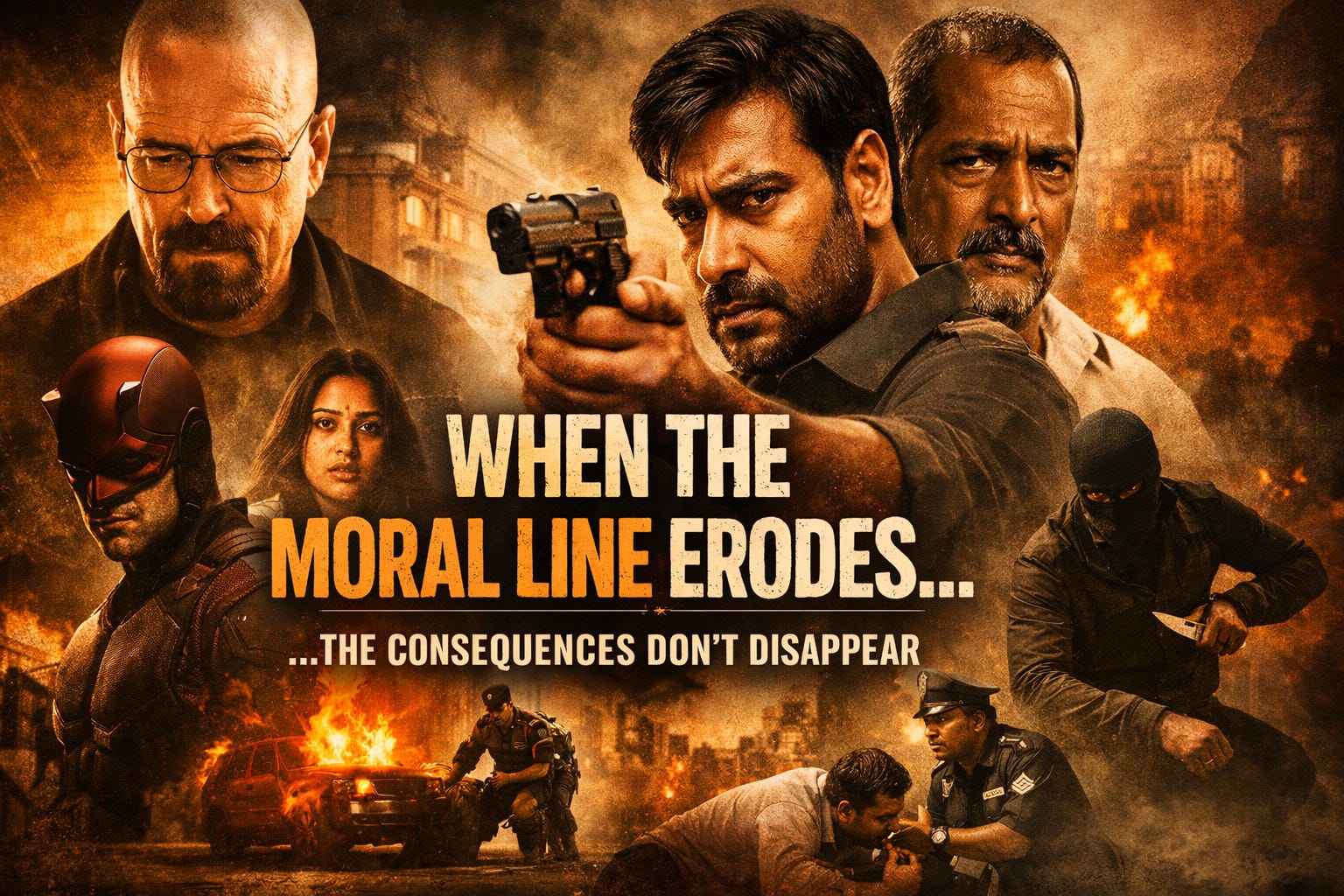
Comics Figured This Out Early
Batman, The Punisher, Daredevil… they weren’t designed to be consumed in one sitting. Their stories stretched across decades. You didn’t just see who they were. You saw how they changed. How their moral lines blurred. How guilt, obsession, and contradiction built up over time like scar tissue.
Every time one of those characters is compressed into a movie, a big piece of their life gets lost. Seriously. Think about your LinkedIn profile. Are you defined by your Linkedin profile? I sure hope not!
Now imagine if you could actually share your life story on LinkedIn without being afraid. Imagine being able to fill in the gaps in your resume by diving deep into how you realized your life long dream of becoming a writer through opening up a Substack account.
Perspective Changes Everything
In a standalone movie, you’re usually locked into one point of view: the hero’s. The villain becomes a prop. A threat. A symbol.
There’s no time to ask: What made them this way? What did they lose before they became dangerous?
One of the greatest pieces of content I ever stumbled across was Star Wars: The Clone Wars.
For years, I wondered what happened to Darth Maul after Obi-Wan cut him in half. In the movies, he was just gone. No arc. No aftermath. Just silence.
But The Clone Wars changed everything.
Maul survived…barely. Kept alive by sheer hatred and obsession with Obi-Wan through the raw power of the Dark Side. It was the first time I realized: the Dark Side wasn’t just the “evil” version of the Force. It was its own energy. Its own will.
It made sense. If the Force exists, how could there not also be a dark version of it?
That kind of character development would never fit into a single movie. There’s no time. No patience. And most audiences wouldn’t sit still for it.
But in a serialized story, there’s room.
You can start with the hero. Then let the villain speak.
Suddenly, the story isn’t good vs evil anymore. It’s about two wounded people, shaped by different losses, wielding different weapons…sometimes chasing the same goal.
Now you’re not just building a story. You’re building a universe. And if you do it right, you expand your reader’s mind right alongside it.
By the way, don’t tell me you didn’t think of samurai cinema during the Darth Maul vs Qui-Gon Jinn & Obi-Wan Kenobi:
The Real Power of Serialization: Consequence
In movies, the main character crosses a line, and by the end, that tension is usually resolved. But real life doesn’t work that way, and this can only explored when you have time to explore it.
A decision made in chapter two should haunt chapter twenty:
The moral line doesn’t snap - it erodes.
Supporting characters don’t stay static - they evolve, fracture, rebel.
Relationships don’t just serve the plot - they change it.
We can see this play out in a movie called Apaharan ( run time almost 3 hours!). In the movie, A young man, desperate to join the police force and earn respect, is rejected due to corruption. To get ahead, he fakes a kidnapping with friends, but it backfires. Instead, he gets pulled into a real criminal kidnapping ring led by a powerful local don. Over time, he becomes part of the very system he once wanted to fight against.
The crazy thing is that his guy ends up earning more respect as a local don then he ever would have as a cop. Just look at this entry:
Why This Format Belongs on Substack
Serialized fiction gives you room to explore all of it without rushing. It lets the reader live inside the tension, the silence, the fallout. It gives space for grief. Space for doubt. Space for regret.
In the end, serialized fiction isn’t just a different format. It’s a different philosophy of storytelling. It takes pride not in the beginning and the end, but in the middle.
Right on! Love this exploration of story in its different forms you gave us here!