


At some point we forgot what a vigilante was.
We turned them into action figures. Gun-toting, rooftop-posing, bulletproof icons with moral catchphrases and six-pack abs.
While a good Stallone, Van Damme, or Schwarzenegger movie have their place, a strong vigilante story is centered around a common man (or woman) grounded in pain, often failed by the state or those they look to for survival. They have been wronged and exhausted all avenues of remedy. They possess nothing but their wits and their passion to make right what was wronged to them. This extends beyond revenge. It includes the utmost reengineering of a society that has left our character in dire straights. Since they are forced to fend for themselves, even if they have a good heart, they have been darkened through the experience of humiliation.
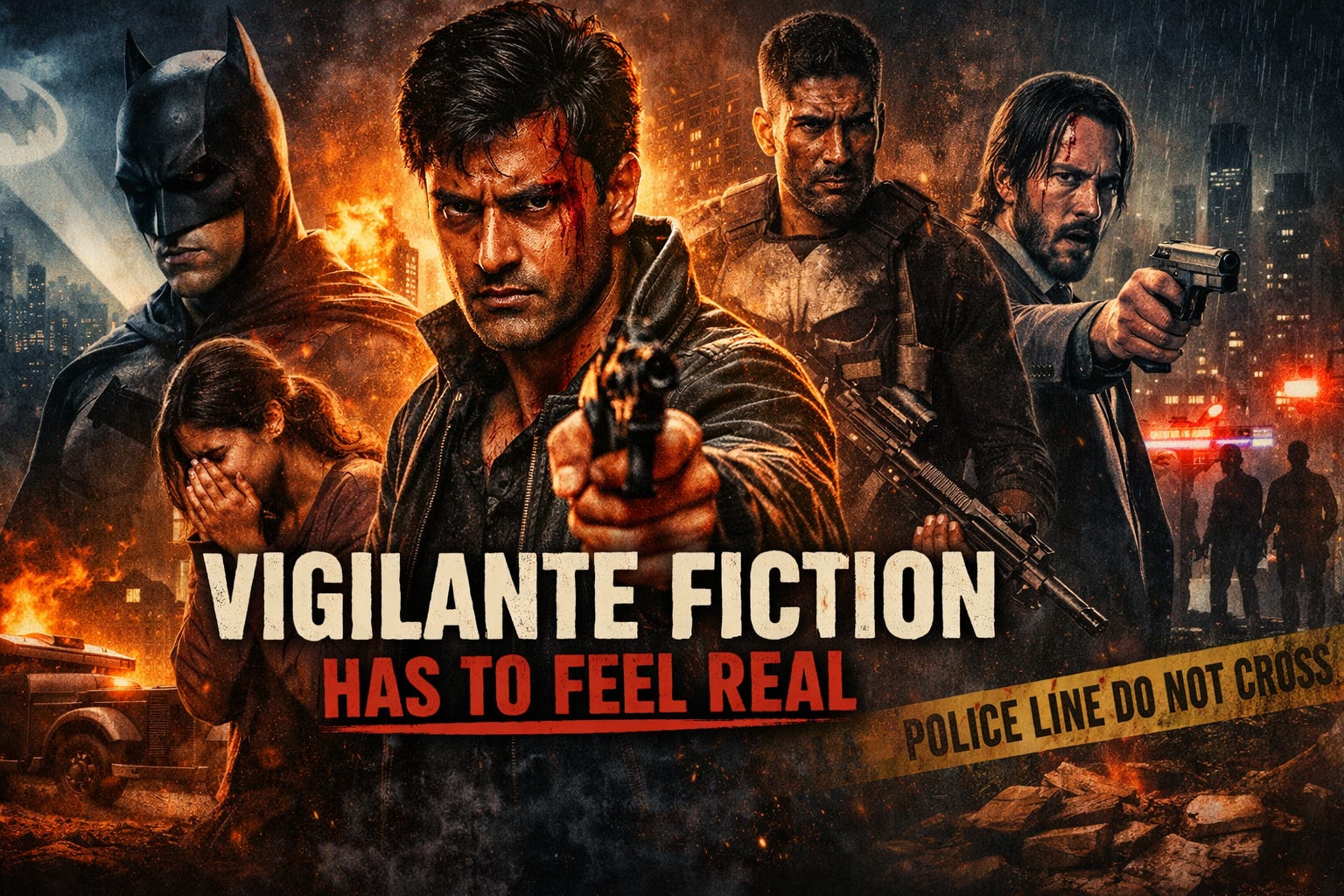
We Need Relatable Heroes.
Lets talk Batman.
There’s something hauntingly believable in his origin: a child watches his parents get murdered. That kind of trauma rewires a person. It’s a moment that lingers forever. But then the story speeds off into fantasy. Bruce Wayne is a billionaire with military-grade tech and a butler who might as well be AI.
With his wealth he could end poverty, reform the police, and fund crime prevention. But instead, he puts on a suit and breaks jaws.
This same sentiment is expressed by Dagestan Imams:
Who knew the internet still had space for something this groundbreakingly thought-provoking? Sorry if I just ruined your childhood.
But they touch on something import. The plot hole here is between the pain and the response. It’s where Batman starts to feel less human. Because of this reason, batman can never truly graduate to something truly adult, no matter how dark you make him.
Bollywood Got It Right
Now contrast that with a film like Mohra, a 1990s Bollywood classic. It’s not high art. But it gets the vigilante formula right.
The main character, Vishal, is an ordinary man. Not rich. Not powerful. Just a brother. And when his sister is assaulted and the criminals walk free thanks to influence and corruption, Vishal becomes what the system refuses to be: a consequence.
He doesn’t become a hero. He becomes a weapon.
But here’s where it gets honest: Vishal goes to prison. His violence has weight. It solves nothing neatly. It costs him something.
Now, we hope that no one ever goes through what this character went through. But here’s the thing: the events are within the realm of possibilities. Stories like this exist. People are assaulted in the worst possible way and the perpetrators walk free. Hell, this is our political landscape right now, and Mohra is a mirror of that landscape.
And even in jail, he’s still a do-gooder, a protector, a Mohra (weapon):
Why This is Important
I didn’t realize it at the time, but I first resonated with vigilante fiction when I changed schools.
We moved districts. New building, new faces, new rules. And I got bullied. Thankfully I was able to escape from my bully by simply changing the route I took home. But my pains at that school didn’t end. Everything was different. It was like stepping into a whole new world, and I made the mistake of trying to fit in. After several embarrassing moments, including getting pantsed in the middle of gym class, I decided that I didn’t care about fitting in. I was going to mold myself into someone people just didn’t want to mess with. And that became the grounding point of my personality.
There were no fists thrown. No revenge plot. But something internal hardened. Something broke, and it too me years to realize it. Small betrayals can accumulate into rage. It’s a slow burn that doesn’t make you evil. It makes you human. It gives you the fire to change your personality, but while the changes are happening, you can’t tell if they are right or wrong. You can only look back and see, in hindsight that precise moment where your life was turned upside down.
This is also why The Fresh Prince always resonated with me:
When Characters Actually Feel Human
The Punisher works because he’s not noble. He’s not trying to be morally pure. He’s broken. A military man whose family was murdered, and who now lives in the grey space between justice and vengeance. He knows what he’s doing isn’t right, but it makes little difference to his pursuit of quenching that deep uneasy within him, a failure of a father, a failure of a husband who couldn’t protect his wife and kids. It’s the ultimate nightmare scenario of any man who has built up a family and his only job, his one job, is to protect them. It’s a bond broken that can never be repaired, regardless of the body count.
Then there’s John Wick. Everyone told me I’d love it. But I just couldn’t care. I tried to care about that character, but I just didn’t understand why I should care. For one thing, the choreography is too polished. The next issue, and this is that the emotion disappears in the body count.
The Punisher isn’t about the body count. It’s about trying to numb the pain.
John Wick, on the other hand, is only about the body count. Kill everyone that comes after you.
Why?
Because they’re getting paid. And that’s where the story loses me. If I was offered a million dollars to kill a man, but knew there was a high chance I’d end up dead too, I wouldn’t take the job. I’d go mop floors or clean toilets or stack pallets. At least then I’m still breathing and still feeding my family.
Now that’s the story I want to see.
What kind of man chooses death for money? What kind of life makes violence seem like the better option? That’s not just a hitman story, that’s a tragedy.
And that’s where the real narrative lives. Without realism, it’s just cool violence. Without pain, it’s just choreography. Without motivation, it all falls flat and you waste three hours of your life watching a high budget film designed to put a dent in your pocket.
Don’t get me wrong, the Punisher also has some cool fight scenese, and Jon Bernthal did a great job of honing in that rage through the fight choreography:
The Final Blow
Vigilante fiction isn’t about power fantasies. It’s about powerlessness.
It’s about what happens when a person gets pushed past the point of return. And if that person doesn’t feel real, if we don’t understand why they break, then it’s just another masked figure doing violence we’ll forget by next week.
I feel the same about John Wick. It feels hyper choreographed, and John wick has become invincible by the 3rd entry.
One aspect of vigilante films is the sense of vulnerability. They are ordinary people reacting with outrage and frustration. There's the possibility that they can fail in their quest for justice, and they struggle because they often don't know what they're doing.
Great post 👍🏾